Queen Bee Marking Color Chart by Year
Look up the international queen bee marking color for any year. Track queen age with the 5-color rotation system.
The international queen marking color system uses a 5-color rotation to help beekeepers track queen age at a glance. A small dot of colored paint on the queen's thorax instantly tells you what year she was raised. No record-keeping required. This tool lets you look up the correct color for any year and calculate how old your existing queens are.
Calculator
Look Up Color
What year was (or will be) the queen raised?
Queen Age Calculator (Optional)
Optional - helps you remember which queen
Leave blank if you just want the color lookup
2026 Queen Marking Color
Years ending in 1 or 6
Track your queens in Apiary Tools
Start tracking freeColor Reference
The Color Cycle
This is a mnemonic. The first letter of each word matches the color: Will = White, You = Yellow and so on.
Will
1/6
You
2/7
Raise
3/8
Good
4/9
Bees?
5/0
White: Years ending in 1 or 6
Yellow: Years ending in 2 or 7
Red: Years ending in 3 or 8
Green: Years ending in 4 or 9
Blue: Years ending in 5 or 0
Assumptions & Notes
- The international color code helps beekeepers track queen age at a glance.
- The 5-year cycle repeats, so colors recur every 5 years.
- Mark queens on the thorax with a small dot of paint or a numbered disc.
- Most queens are productive for 2-3 years, though some last longer.
- Marking also helps confirm your queen hasn't been superseded.
The chart, ready to print
Save this chart, print it and tape it inside a hive lid or on the shop wall. It covers every year through 2035, so it never goes out of date.
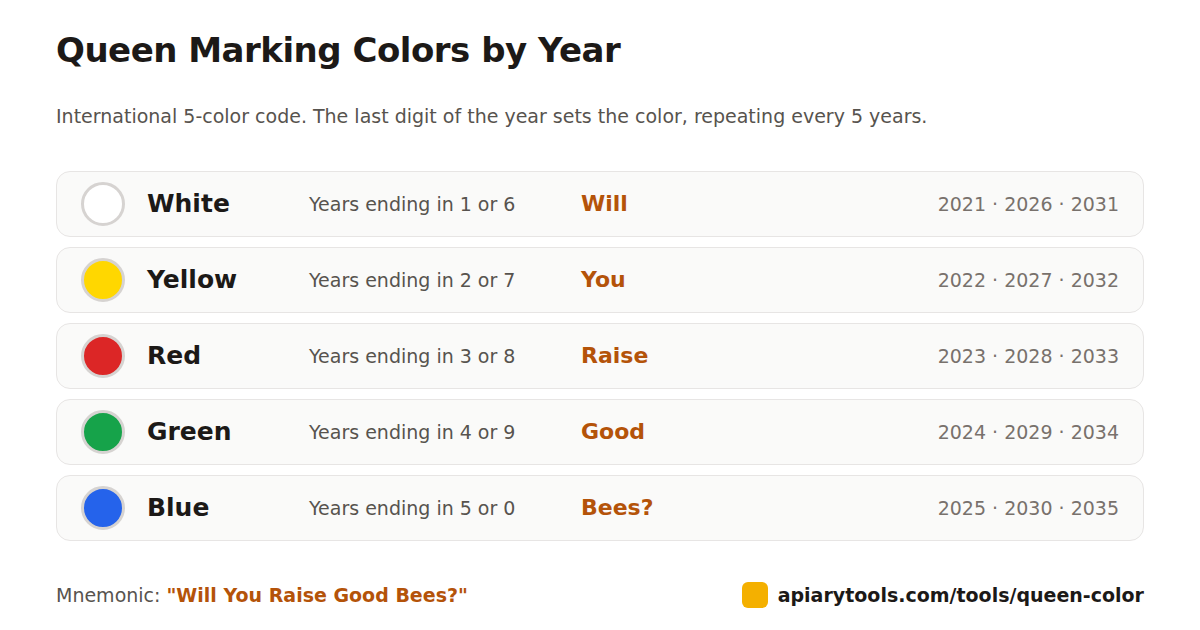
Tap the chart to download the full-size image. Free to share and reprint, credit appreciated. For how to actually mark and spot her, see the queen bee marking and identification guide.
International Queen Marking Color Code
The color system follows a simple 5-year cycle based on the last digit of the year. Outside the US it is usually spelled the queen marking colour code, but it is the same international system.
Ends in 1 or 6
2021, 2026
Ends in 2 or 7
2022, 2027
Ends in 3 or 8
2023, 2028
Ends in 4 or 9
2024, 2029
Ends in 5 or 0
2025, 2030
Mnemonic
Using the Queen Color Tool
Enter any year to see the corresponding marking color, or use the queen age calculator:
Look up any year
See the marking color for past, present or future queens
Track queen age
Enter install year to see how many seasons she's been laying
Get recommendations
See productivity guidance based on queen age
Why Mark Your Queens?
Easier to find
A bright dot makes the queen stand out on a crowded frame
Age tracking
Tell at a glance whether a queen is young or due for replacement
Supersedure detection
An unmarked queen means the original was replaced
Record verification
Confirm you're looking at the queen you think you are
How to Mark a Queen
Find the queen and gently catch her with a queen catcher, marking tube or your fingers
Apply a small dot of paint to the center of her thorax (between head and abdomen)
Let the paint dry for 30-60 seconds before releasing her back to the hive
Tools: Queen marking pens (Posca, Uni-Paint), purpose-made paint or press-on numbered discs. Keep the dot small and avoid getting paint on her head, wings or abdomen.
Queen Productivity by Age
Young queen building laying rate. Solid brood patterns.
Laying rate highest. Brood patterns should be excellent.
Most queens still good. Watch for signs of decline.
Laying rate often decreases. Spotty brood more common.
Some queens remain excellent for 4-5 years, while others decline in year 2. Use brood pattern and temperament, not just age, to decide when to replace.
Frequently Asked Questions
Do I have to mark my queens?
No, marking is optional but highly recommended. A marked queen is much easier to find during inspections, and the color tells you her age at a glance. Marking also confirms whether your original queen is still present or has been superseded by a new, unmarked queen.
What paint or marker should I use?
Use queen marking pens (Posca, Uni-Paint), queen marking paint with applicator sticks or press-on numbered discs. Water-based paint pens are popular and dry quickly. Avoid nail polish or regular markers as they may contain chemicals harmful to bees. Whatever you use, apply a small dot only on the thorax.
What color are 2026 queens? What about 2027?
2026 queens are marked WHITE, and 2027 queens are marked YELLOW. The five colors repeat every five years. Use the color lookup above to find any year.
Why does the color cycle repeat every 5 years?
The 5-year cycle matches the typical maximum lifespan of productive queens. Most queens are replaced within 2-3 years, so a 5-color rotation ensures you can always tell the difference between a current queen and an old one. If you see two different colors, you know one is at least 5 years newer.
How do I remember the color order?
Use the mnemonic: 'Will You Raise Good Bees?' The first letter of each word matches the color: White (1/6), Yellow (2/7), Red (3/8), Green (4/9), Blue (5/0). The last digit of the year tells you the color.
Related Tools
Embed this calculator on your website
Club site, blog or shop? This calculator is free to embed. Paste the code below into your page's HTML; it sizes itself automatically. All we ask is that you keep the credit link underneath.
<iframe src="https://apiarytools.com/embed/queen-color" title="Queen Marking Color Tool" loading="lazy" style="width:100%;border:0;border-radius:12px;background:#fff" height="700"></iframe>
<p style="font-size:12.5px;margin-top:8px;text-align:center;color:#78716c;font-family:system-ui,-apple-system,sans-serif">
	<a href="https://apiarytools.com/tools/queen-color" style="color:#b45309;font-weight:600;text-decoration:none">Queen Marking Color Tool</a> · more <a href="https://apiarytools.com/tools" style="color:#b45309;font-weight:600;text-decoration:none">free beekeeping tools</a>
</p>
<script>
if (!window.__apiaryEmbedResize) { window.__apiaryEmbedResize = true;
window.addEventListener("message", function (e) {
	if (e.origin !== "https://apiarytools.com" || !e.data || e.data.type !== "apiary-embed-height") return;
	document.querySelectorAll('iframe[src^="https://apiarytools.com/embed/"]').forEach(function (f) {
		if (f.contentWindow === e.source) f.style.height = e.data.height + "px";
	});
}); }
</script>