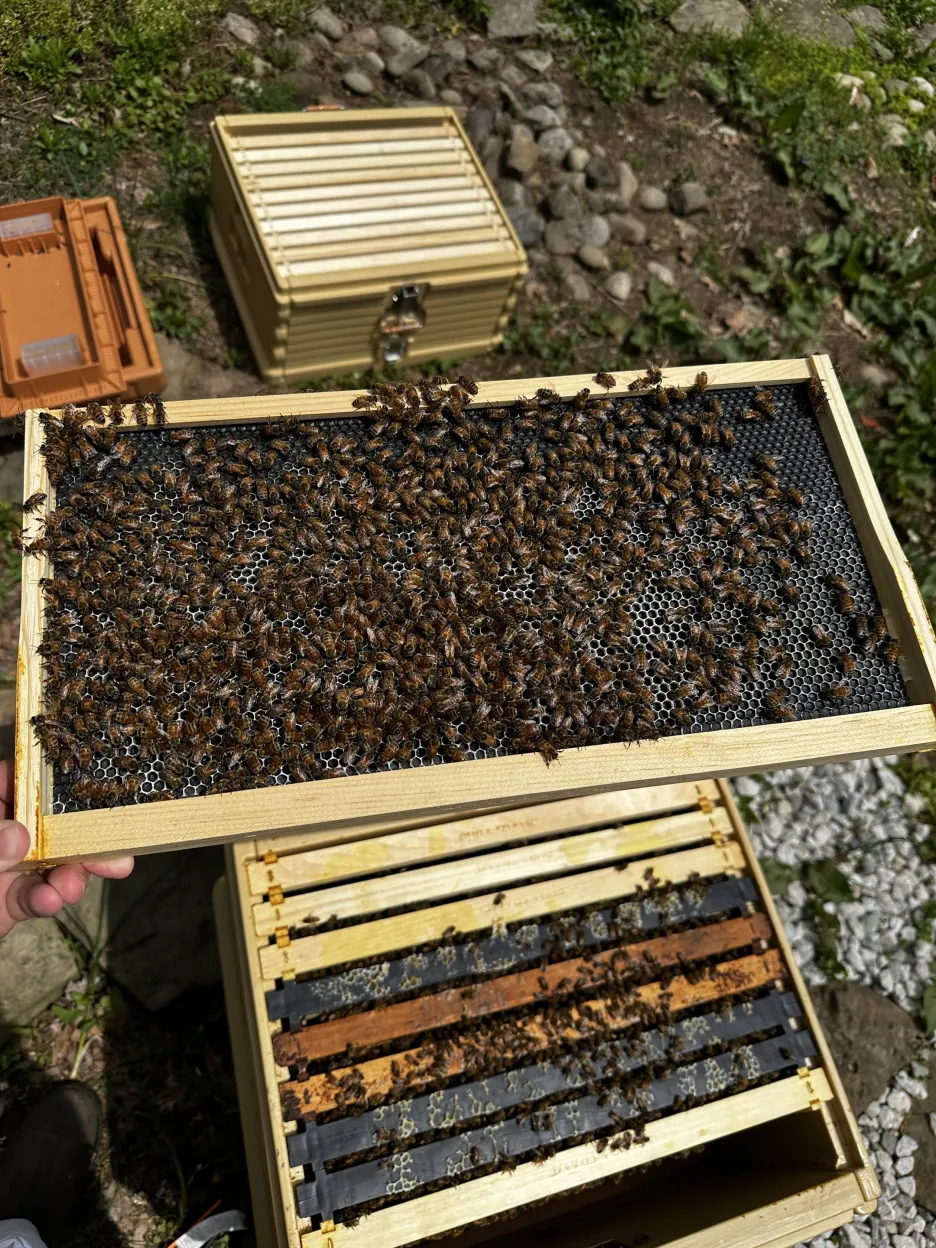
Before you start
A walk-away split only works if a few things are in place. Check these first:
- A strong, healthy colony with plenty of bees and brood to spare.
- Eggs or very young larvae present, because that is what the bees turn into an emergency queen.
- Drones flying in your area, since the new virgin queen needs them to mate.
- Reasonable weather and some forage, so both halves can keep building.
If the colony is weak, or there are no eggs or it is too cold and early for drones, wait. A split made at the wrong time just gives you two struggling colonies instead of one strong one.
How to make the split, step by step
The goal is to end up with two boxes that each have everything they need, with the queenless half holding the material to raise a queen.
- Set up a second box with frames at your chosen location.
- Open the strong colony and find the frames with eggs and young larvae.
- Split the brood, bees and stores roughly evenly between the two boxes. Each side needs covering bees, some capped brood, pollen and honey.
- Make sure the half that will be queenless has at least one or two frames of eggs or very young larvae, plus plenty of nurse bees to feed the queen cells.
- Decide where the queen goes. Usually she stays in one box and the other raises a new queen. If you cannot find her, splitting eggs and young larvae into both halves means whichever side is queenless will still raise a queen.
- Reduce the entrances, especially on the smaller or queenless side, to help them defend against robbing.
- Close up and walk away. Leave the queenless half alone for about three weeks.
What to expect, day by day
Once the queenless half realizes it has no queen, it gets to work fast. Here is the rough sequence. The dates shift with weather and how old the larvae were when they started.
| When | What is happening |
|---|---|
| Day 0 | You make the split. The queenless half is now without a queen. |
| Day 1 to 3 | The bees choose young larvae and start building emergency queen cells. |
| Day 7 to 9 | Queen cells are capped. |
| Day 12 to 16 | A virgin queen emerges. |
| Day 17 to 27 | Orientation and mating flights, weather permitting. |
| Day 21 to 34 | The mated queen begins laying. This is your sign the split worked. |
So plan on roughly three to four weeks before you see eggs, sometimes a little more. The timeline tool above will turn your actual split date into real dates to watch.
The one rule: leave them alone
If there is a single thing that decides whether a walk-away split works, it is patience. The queenless half needs to raise a queen, let her emerge and let her mate, all without you opening the box and disturbing it.
A simple way to think about it:
Resist checking for the first three weeks.
Your first real inspection is about looking for eggs, not for the queen.
Opening the hive during the mating window is the most common way to lose a virgin queen, either by disturbing her or by rolling her on a frame. A quiet hive is doing exactly what you want.
When it does not work
Sometimes the queen fails to mate, gets lost on a flight or the colony never had usable larvae. If you are well past four weeks with no eggs, check for two things: a complete absence of brood, and signs of laying workers such as multiple eggs per cell or eggs on the cell walls.
A frame of open brood from another hive is your best friend here. If the split builds queen cells on it, they were queenless and now have a path forward. If you confirm there is no hope of a queen, the quickest recovery is to introduce a mated queen or to recombine the split back into a queenright colony and try again later.
A split is one more thing to keep an eye on for the better part of a month. If you would rather not run it from memory, you can log the new colony in My Hives and let it remind you when to look for eggs.