Count first, treat second
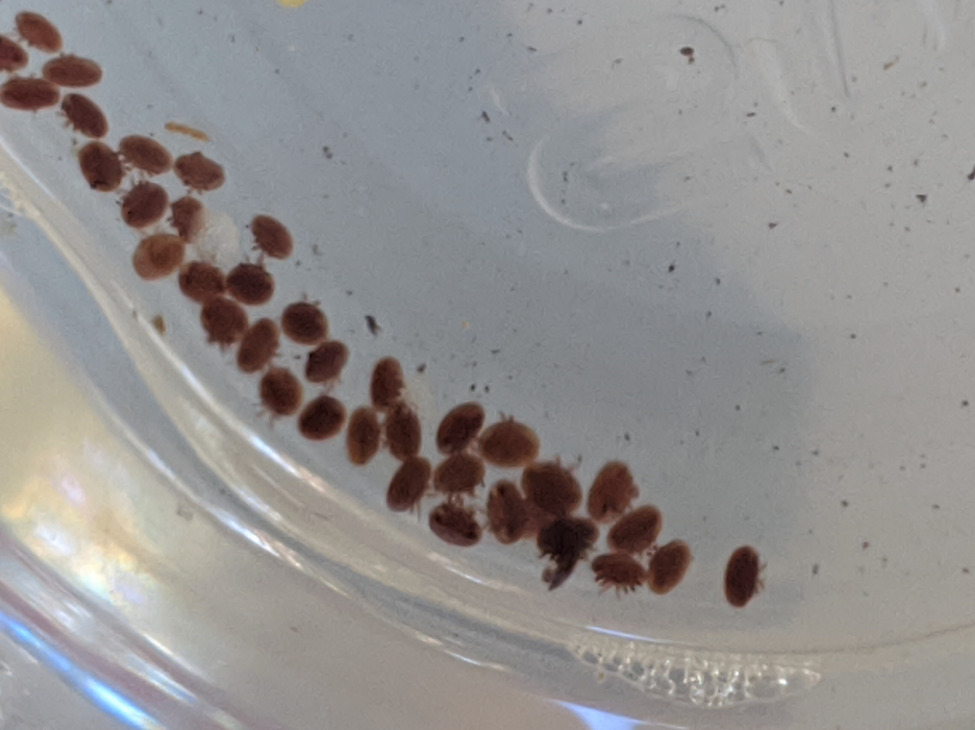
Looking at bees tells you almost nothing about mite levels, because most mites are sealed inside capped brood. The only numbers worth acting on come from an alcohol wash or a sugar roll of roughly 300 bees, which is about half a cup, shaken from a brood frame after you have made sure the queen is not on it.
Count the mites, divide by three and you have mites per 100 bees. Nine mites in a wash is 3 percent. That single number drives every treatment decision below, and it belongs in your inspection notes every time you measure it. For the wash step by step, see how to check for varroa mites, and once you are over threshold, which treatment should I use walks the choice.
The thresholds that should trigger a treatment
| Season | Treat at | Why the difference |
|---|---|---|
| Spring buildup | 2 to 3 mites per 100 bees | Mite loads grow with the brood nest. A 2 percent spring count becomes a dangerous fall count if ignored. |
| Late summer | 3 mites per 100 bees | This is the count that decides whether your winter bees are raised healthy. Do not skip this test. |
| Fall and winter | Any meaningful count | With little or no brood, mites are exposed and a broodless oxalic treatment is cheap insurance. |
Thresholds vary a little between extension services, and regional pressure differs. If your local club or bee inspector publishes numbers, use theirs. The principle does not change: decide from a count, not from a calendar or a feeling.
The late summer window is the whole game
The bees that get your colony through winter are raised from roughly August through early October. Those winter bees need to be raised by nurse bees that are not riddled with mites, in brood that is not being parasitized.
That means the knockdown has to happen before the winter bees are raised, not after. For most of the northern hemisphere, the treatment should be on the hive in August or very early September, which usually means testing in late July. Treating in October still kills mites, but the damage to the winter generation is already done.
Work backward from your harvest. If you pull supers in early August, you can test the same week and have a treatment on within days. If your flow runs later, look at formic-based products that are labeled for use with supers on, and check the treatment comparison for what fits your temperatures, since several products have hard upper limits in summer heat.
A year of varroa management at a glance
| When | What to do |
|---|---|
| Early spring | First wash once the colony is active. Treat if over threshold, before supers go on. |
| Late spring and early summer | Monthly washes. Splits and swarms give a natural brood break that knocks mites back. |
| Late July | The test that matters most. Plan the post-harvest treatment from this count. |
| August to early September | Main treatment, immediately after supers come off. Re-test after to confirm it worked. |
| Late November to December | Broodless oxalic acid treatment to clean up before the new year. |
Two mistakes I see every year
The first is treating and not re-testing. Every treatment can fail, whether from temperature, resistance or a bad application. A wash two weeks after the treatment ends is the only way to know it worked, and it is the difference between fixing a failure in September and finding it as a dead-out in January.
The second is ignoring your neighbors. A collapsing colony within flying distance sheds mites into every hive around it as robbers carry them home. If a late fall count suddenly spikes after your successful summer treatment, that is usually what happened. It is also why one untested hive in your own yard puts the rest at risk.
Track every count and treatment in your hive records. The pattern across seasons tells you more than any single number, and next July you will want to know what worked this year.