Varroa Mite Count Calculator
Turn a mite wash count into your infestation rate and a clear treat or monitor answer for the time of year.
Count the mites in a sample of about 300 bees and you know how infested the colony is, measured as mites per 100 bees. Enter your count below to get the rate and whether it is time to treat for the season you're in.
Calculator
Your sample
Colony phase
The treatment threshold depends on the time of year.
Over threshold
Infestation rate
2%
6 mites in 300 bees
Treat at
2%
Peak Population
Treat soon
At 2% (6 mites / 300 bees), this colony is at or above the 2% Peak Population threshold. Treat now with a registered, seasonally appropriate miticide per its label, then re-sample after treatment to confirm it worked.
Your method: Alcohol or detergent wash: the most reliable method, with 95%+ mite recovery when you swirl (do not shake) for about a minute. It kills the roughly 300 sampled bees.
Assumptions & Notes
- Thresholds follow the Honey Bee Health Coalition's Tools for Varroa Management guide (9th edition, June 2026): 1% for the dormant and population increase phases, 2% for the population peak and decrease phases.
- A level half cup of bees is counted as 300 bees (it actually holds about 315).
- Infestation rate is mites divided by bees, times 100. Sampling is an estimate, and a 0% count does not prove a colony is mite free.
- Sampling notes draw on Randy Oliver's mite wash work at scientificbeekeeping.com.
Treatment thresholds by colony phase
Mite levels are usually given as a percentage, meaning the number of mites per 100 adult bees. Below the threshold for the current phase, keep monitoring. At or above it, treat with a registered product that suits the season.
| Colony phase | When | Treat at |
|---|---|---|
| Dormant | Winter cluster, little or no brood | 1% |
| Population Increase | Spring build-up, pre-honey flow | 1% |
| Peak Population | Summer peak, honey supers on | 2% |
| Population Decrease | Post-harvest, rearing winter bees | 2% |
Treat the threshold as a ceiling, not a target. Randy Oliver keeps his colonies below 2% (6 mites per half cup) to stay clear of virus epidemics, but he treats far more proactively than that: in his own operation he does not want to see more than a single mite per half cup in spring, and he aims to catch infestations below 1% (3 mites per half cup) before they build. It is much easier to keep mites low than to pull them back down once they have climbed, especially heading into winter when the colony is raising the bees that have to survive until spring. So if your count is creeping toward the threshold, do not wait for it to cross.
Sources: Honey Bee Health Coalition, Tools for Varroa Management (9th edition, June 2026) and Randy Oliver, Scientific Beekeeping: Monitoring Varroa.
Printable threshold card
Save this card and tape it inside a hive lid or on the shop wall. The wash math and the seasonal thresholds at a glance.
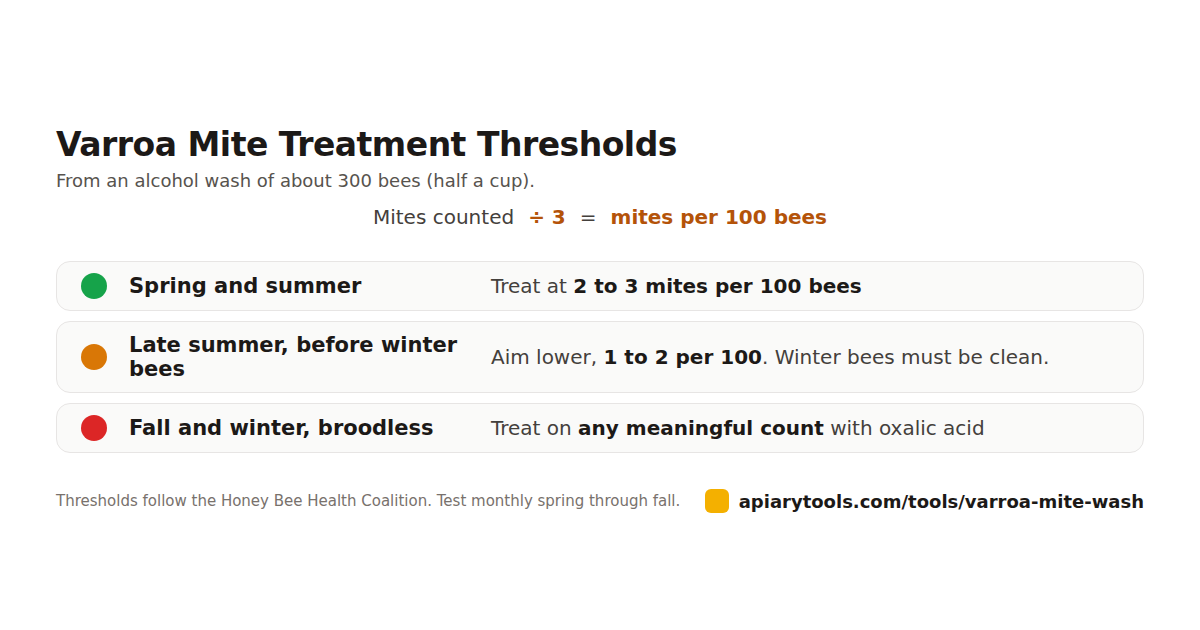
Tap the card to download the full-size image. Free to share and reprint, credit appreciated.
How to do a mite wash
- Find a frame of open brood in the top brood box and check the queen is not on it.
- Shake the bees into a tub, then scoop a level half cup (about 300 bees) into your wash cup.
- Add 91% alcohol, windshield washer fluid or Dawn-type detergent in water (about 1 tablespoon per 2 litres).
- Cap it, wait a minute, then swirl gently for about a minute. Hard shaking pushes mites back up into the bees.
- Strain and count the mites, then enter the numbers above.
For the full walkthrough, how the wash compares to a sugar roll or sticky board and how often to test, see the guide on how to check for varroa mites. Once you are over threshold, the which treatment guide helps you pick one.
Which sampling method to use
Alcohol / soap wash
The most reliable, about 95% of mites recovered in a minute. It kills the 300 sampled bees, a tiny fraction of the colony.
Powdered-sugar roll
Non-lethal but less consistent. Recovery can drop below 70%, so it can read low. Confirm borderline counts with an alcohol wash.
CO₂ injectors
Fast and non-lethal, but recovery varies, so treat the count as a floor. Ether roll and gasoline are unreliable or unsafe, so skip them.
Frequently Asked Questions
How many mites is too many?
The common guideline is 1 mite per 100 bees (1%) during the dormant and spring build-up phases, and 2 per 100 bees (2%) at the summer peak and after the harvest. At or above the threshold for your phase, treat soon. These numbers are conservative and can vary by region, so check with your local inspector or extension service.
How do I get the percentage from a mite count?
Divide the mites you counted by the number of bees, then multiply by 100. A level half cup of bees is about 300 bees, so a quick shortcut is to divide your mite count by 3. Six mites in a half cup is 6 divided by 3, which is 2%.
Is an alcohol wash or a sugar roll more accurate?
An alcohol or detergent wash is more reliable. It pulls out about 95% of the mites in a minute of gentle swirling, but it kills the sampled bees. A sugar roll is non-lethal but less consistent, sometimes recovering under 70%, so it can read low. If a sugar roll count is near the threshold, confirm it with an alcohol wash.
Where should I take the bee sample?
Shake bees from a frame of open brood in the top brood box, where nurse bees and mites gather. Check that the queen is not on the frame before you shake. A sample from the outer honey frames will read low.
My count is below the threshold. Am I done?
No. Mite numbers climb fast once brood is capped. Sample again monthly through the season, and more often as the colony raises its winter bees. A low count right after treating also tells you the treatment worked.
Related Tools
Embed this calculator on your website
Club site, blog or shop? This calculator is free to embed. Paste the code below into your page's HTML; it sizes itself automatically. All we ask is that you keep the credit link underneath.
<iframe src="https://apiarytools.com/embed/varroa-mite-wash" title="Varroa Mite Wash Calculator" loading="lazy" style="width:100%;border:0;border-radius:12px;background:#fff" height="1000"></iframe>
<p style="font-size:12.5px;margin-top:8px;text-align:center;color:#78716c;font-family:system-ui,-apple-system,sans-serif">
	<a href="https://apiarytools.com/tools/varroa-mite-wash" style="color:#b45309;font-weight:600;text-decoration:none">Varroa Mite Wash Calculator</a> · more <a href="https://apiarytools.com/tools" style="color:#b45309;font-weight:600;text-decoration:none">free beekeeping tools</a>
</p>
<script>
if (!window.__apiaryEmbedResize) { window.__apiaryEmbedResize = true;
window.addEventListener("message", function (e) {
	if (e.origin !== "https://apiarytools.com" || !e.data || e.data.type !== "apiary-embed-height") return;
	document.querySelectorAll('iframe[src^="https://apiarytools.com/embed/"]').forEach(function (f) {
		if (f.contentWindow === e.source) f.style.height = e.data.height + "px";
	});
}); }
</script>