What you need
- A wash cup or a wide mason jar. A dedicated shaker like the Varroa EasyCheck works, or two jars, one with a screen lid.
- A half-cup measure. Half a cup of bees is about 300 bees, which is the standard sample size.
- Seventy percent isopropyl alcohol, or water with a strong squirt of dish soap.
- A white tray or bowl to strain into, so the dark mites show up against the light background.
Why a wash and not just a look
At any moment most of the mites in a colony are hidden under the cappings, feeding on the developing brood. The mites you see riding on adult bees are the small visible fraction. That is why crushing a few drone pupae or eyeballing the bees misses the problem until it is advanced. A wash shakes the mites off a real sample of bees and gives you a rate you can compare to a threshold. The alcohol wash is the method most authorities list first for accuracy.
The wash, step by step
- Find a frame of open brood and make sure the queen is not on it. The nurse bees on brood frames carry the most mites, so this is where you want your sample. If you are nervous about the queen, move her frame aside first.
- Shake or brush bees from that frame into a tub, then scoop a rounded half cup, about 300 bees, and tip them into your wash cup.
- Cover the bees with alcohol or soapy water. Put the lid on and swirl and shake hard for 60 to 90 seconds. You are trying to break the mites loose, so do not be gentle.
- Strain the liquid through the screen into your white tray. Give the bees a second rinse and shake, since a first wash alone can leave some mites behind.
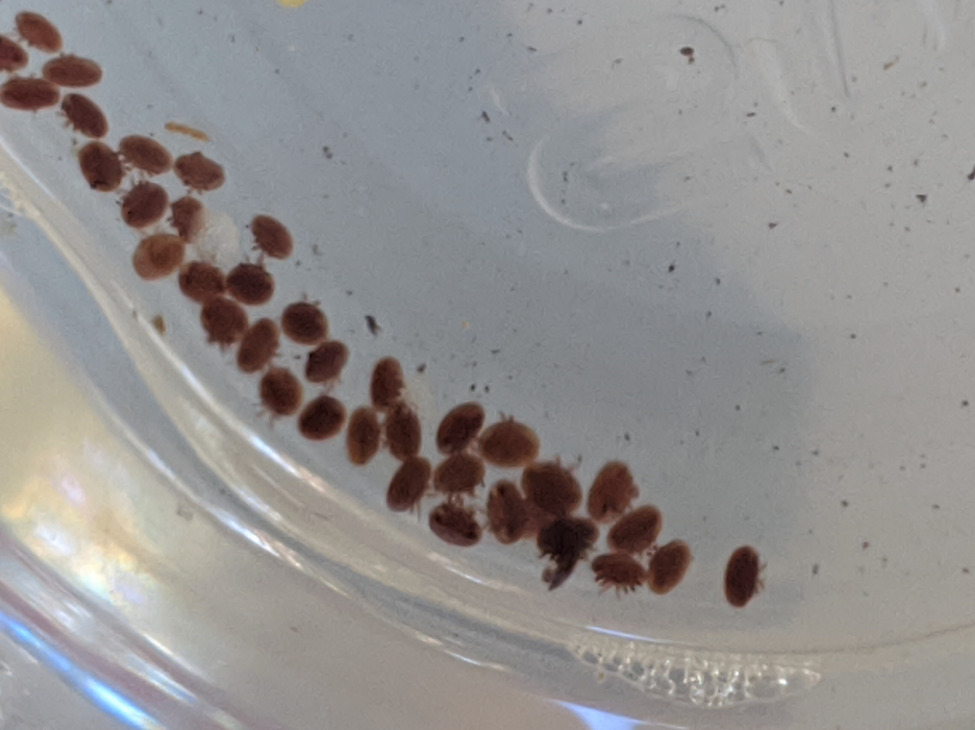
- Count the mites in the tray. They are reddish brown ovals, clearly not bee parts.
Doing the math
Divide the mite count by three and you have mites per 100 bees, which is your infestation rate. Nine mites in a wash of 300 bees is 3 percent. That one number is what every treatment decision hangs on, so write it in your notes every time. If you would rather not do it in your head at the hive, the mite count calculator takes your count and sample size and gives you the percentage plus whether you are over the seasonal threshold.
What the number means
Thresholds vary a little between extension services, but the widely used rule of thumb is to treat at about 2 to 3 mites per 100 bees through spring and summer, and to hold the bar lower, nearer 1 to 2 per 100, in late summer and fall when the winter bees are being raised and need to be as clean as possible. The full seasonal breakdown lives in when to treat for varroa mites.
Wash, roll or board
There are three common ways to count and they are not equal.
| Method | How it works | Trade-off |
|---|---|---|
| Alcohol or soap wash | Shake 300 bees in liquid, strain, count. | Most accurate field method. Kills the sample of 300 bees. |
| Sugar roll | Coat 300 bees in powdered sugar, shake mites out onto a tray, bees go back in. | Bees survive, but it releases fewer mites so it can read low and it is more work. |
| Sticky board | Count mites that drop naturally onto a greased board under a screened bottom. | No sampling of bees, but natural drop is a rough proxy and easily thrown off. |
Randy Oliver, who has washed more samples than almost anyone, puts the alcohol wash first for reliability, then the sugar shake, then drop-based methods. He also notes the wash and a detergent wash give effectively the same result, since both work as a surfactant that breaks the mites' grip. If losing 300 bees stops you from testing at all, do the sugar roll instead. Not testing is the worst option of the three.
How often to check
The Honey Bee Health Coalition recommends a count roughly every 30 days from early spring through fall, plus one right before any treatment and one two to three weeks after to confirm it worked. Miss everything else and still do the late summer test. That count, taken before the winter bees are raised, is the one that decides whether the colony sees spring.
Sources and further reading
The method and thresholds here follow the published guidance below. When your own club or bee inspector gives local numbers, use theirs.
- Honey Bee Health Coalition, Tools for Varroa Management (9th edition). The practical standard for sampling and thresholds in the US and Canada.
- Randy Oliver, Scientific Beekeeping: Mite Monitoring Methods, including his Refining the Mite Wash series comparing wash solutions and accuracy.
- University of Guelph Honey Bee Research Centre, whose alcohol wash video is one of the clearest demonstrations of the method.
- USDA ARS Carl Hayden Bee Research Center: Alcohol Wash.
Log every count in your hive records. One count is a snapshot. The trend across the season tells you whether the mites are gaining on you.